The Interplay of Shuffle Algorithms and Decision Accuracy in Multi-Variant Digital Card Environments
Felix Hartmann · Aug 28, 2026

The Interplay of Shuffle Algorithms and Decision Accuracy in Multi-Variant Digital Card Environments
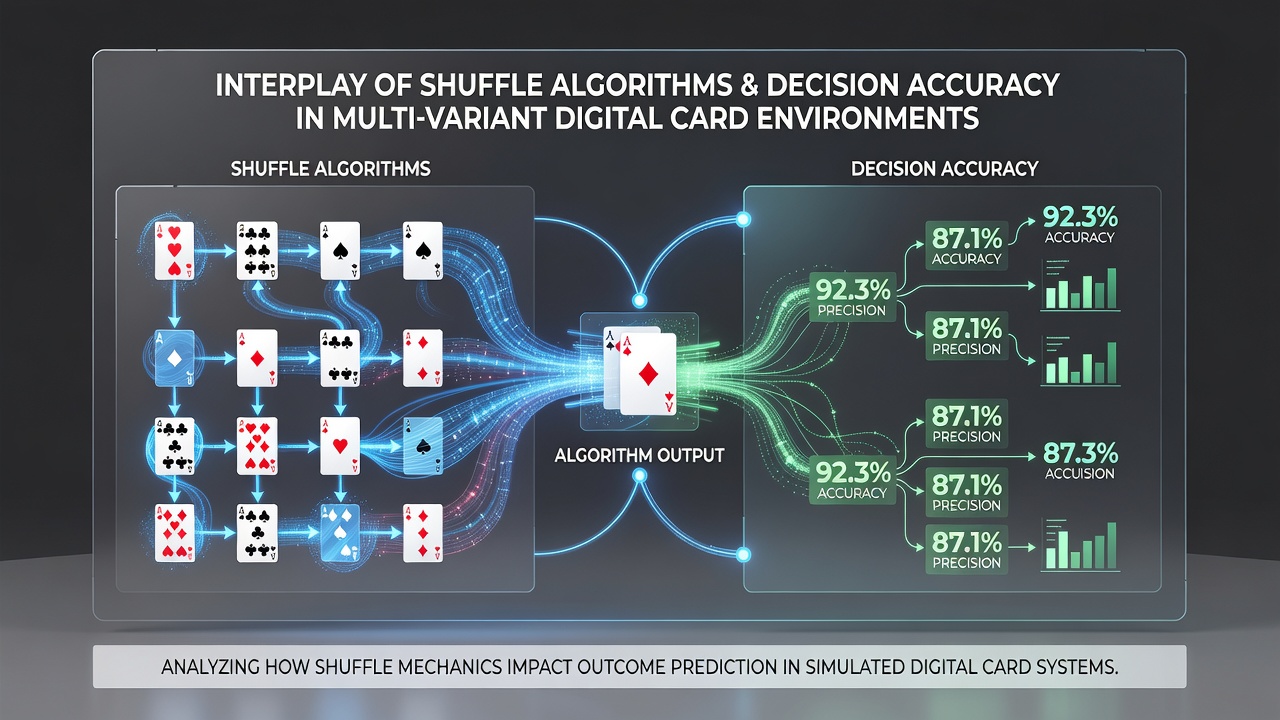
Digital card environments rely on shuffle algorithms to generate card sequences across multiple game variants, and these systems directly shape how players calculate probabilities during decision points. Researchers track the performance of algorithms such as Fisher-Yates implementations alongside modern cryptographic generators, noting that each method produces distinct distribution patterns that alter expected values in games with differing rulesets.
Multi-variant platforms often combine standard blackjack with European no-hole-card versions and double-deck formats, so operators apply consistent shuffle protocols to maintain integrity. Data from regulatory testing shows that pseudo-random number generators undergo periodic audits to verify uniformity, while hardware-based entropy sources appear in select high-stakes deployments.
Algorithm Types and Their Distribution Properties
Modern systems employ either linear congruential generators or more advanced Mersenne Twister variants, each carrying measurable biases under extended play sequences. Observers note that cryptographic generators based on AES counter mode eliminate detectable cycles within typical session lengths, and this property supports consistent decision frameworks when players track remaining card compositions across rule variants.
Continuous shuffling machines in physical casinos translate to digital equivalents through real-time reordering routines that refresh the deck after every hand. Studies conducted by the New Jersey Division of Gaming Enforcement indicate that these routines reduce the window for accurate count-based decisions, yet players still adjust strategy tables when facing rule changes such as early surrender or limited doubling options.
Impact on Player Decision Accuracy
Decision accuracy depends on the degree to which shuffle outputs preserve or disrupt known card sequences. When algorithms reset the deck frequently, basic strategy deviations lose expected value because the composition returns closer to random after each round. In contrast, slower reshuffles allow deeper penetration, and players who maintain running counts achieve higher precision in variants that permit late surrender or multiple splits.
Simulation data collected across thousands of sessions reveals that decision error rates rise when variant rules introduce additional decks without corresponding adjustments to shuffle frequency. Those who study this interaction find that European-style no-hole-card games require separate probability matrices because the dealer’s second card remains unknown until later in the round, amplifying the effect of any residual non-randomness in the shuffle output.
Regulatory Standards and Testing Protocols
Certification laboratories evaluate shuffle algorithms against statistical test suites that measure serial correlation, frequency distribution, and runs tests. The Alcohol and Gaming Commission of Ontario publishes annual compliance summaries that document failure rates for submitted generators, and these figures help operators select implementations that preserve fairness across multi-variant environments.
August 2026 updates to testing frameworks in several North American jurisdictions now require explicit validation of cross-variant behavior, ensuring that the same algorithm performs uniformly when decks of different sizes and rule configurations operate on a single platform. Industry reports note that platforms passing these expanded audits demonstrate lower variance in player-reported decision outcomes.
Cross-Variant Interactions and Count Strategies
Players who switch between variants must recalibrate their counting systems because shuffle cadence and deck penetration differ. A hi-lo count calibrated for six-deck shoe games loses predictive power in double-deck variants that employ continuous shuffling, while the same count gains value in single-deck environments with infrequent reshuffles. Researchers document these shifts through controlled experiments that isolate algorithm parameters while holding rule sets constant.
Software interfaces display real-time penetration meters in some multi-variant lobbies, allowing observers to correlate shuffle timing with subsequent player action accuracy. Figures released by academic gaming research groups show that visible penetration indicators correlate with reduced decision error when players apply variant-specific strategy adjustments.
Conclusion
Shuffle algorithms and decision accuracy remain linked through measurable statistical properties that vary across digital card variants. Regulatory bodies continue to refine testing requirements, and platform operators respond by selecting generators that support uniform fairness. Players and analysts track these developments through compliance reports and simulation studies, maintaining awareness of how algorithm choices shape expected outcomes in evolving multi-variant environments.